Tuesday, September 25, 2007

about yahoo pipes

What is Pipes?

Pipes is a free online service that lets you remix popular feed types and create data mashups using a visual editor. You can use Pipes to run your own web projects, or publish and share your own web services without ever having to write a line of code.

Building a Pipe

You make a Pipe by dragging pre-configured modules onto a canvas and wiring them together in the Pipes Editor.

Each Pipe consists of two or more modules, each of which performs a single, specific task. For example, the Fetch module will retrieve a feed URL, while the Sort module will re-order a feed based on criteria you provide (you can find a complete list of available modules in the documentation.)

Each module has one or more terminals, represented by small circles in the interface. You can wire modules together by clicking on one module's output terminal and dragging the wire to another module's input terminal. Once the terminals are wired together the output from the first module will serve as input to the second module.

In addition to data feeds, Pipes also lets you add user input fields into your Pipe. These show up at runtime as form fields that users of your Pipe can fill in.

The easiest way to understand Pipes is to build one yourself - try editing one of our sample Pipes for a quick start.

Sharing a Pipe

Once you've built a Pipe, you'll be able save it on our server and then call it like you would any other feed. Pipes offers output in RSS 2.0, RSS 1.0 (RDF), JSON and Atom formats for maximum flexibility. You can also choose to publish your Pipe and share it with the world, allowing other users to clone it, add their own improvements, or use it as a subcomponent in their own creations.

Hosted Pipes

A Hosted Pipe is a web-based interface that Pipes provides which allows you to execute a Pipe that you or someone else has built and published. It's a useful mechanism for quickly determining what type of content a Pipe outputs. It is also a jumping off point for subscribing to a Pipe in your favorite feed reader, viewing how the Pipe was constructed, or cloning it so that you can further tweak it yourself.

Here's a very simple example hosted Pipe.

Are Pipes I create private?

All Pipes can be accessed if you know their unique URL. This allows you to share them over IM or email without having to do any configuration, or use them as sub-pipes in your own Pipes without needing to publish them.

Only *you* can get a list of your Pipes ("My Pipes") and their URLs. Therefore, if you don't share the URL with anyone, your Pipe remains private.

What does "Publishing" a Pipe do?

Publishing a Pipe enables the Pipe to be searched, or seen, by others on pipes.yahoo.com. It will appear in the browse page, your Pipes page, and as a search result to anyone on the site.

Can web crawlers index my Pipe?

We allow crawlers to index our site. By default a Pipe is not linked to by any public page in pipes.yahoo.com and therefore cannot be crawled. However, once a Pipe is "Published" it will be accessible to a crawler and may appear in search results.

How to Make a Dependency Diagram inn sql

How to Make a Dependency Diagram in sql


Creating a new database just for dependency diagrams is necessary to avoid cluttering the database of interest with tables that are only for creating dependency diagrams. The script for this task takes the name of the current database and appends Diagram to it. Thus, when the current database is AdventureWorks, the script creates a database named AdventureWorks Diagram. The rest of this article uses those two database names as examples.

A dependency diagram for AdventureWorks is actually created in the AdventureWorks Diagram database, not the AdventureWorks database itself. The script assumes that the database you are diagramming is on your local server and that you want your diagram database to reside on your local server. You may want to modify the Step 1 section of the script if your circumstances are different.

Each database object (table, stored procedure, function, view, etc.) in the AdventureWorks database is modeled as a table in the AdventureWorks Diagram database. You need an easy way to distinguish between the different types of objects modeled in the dependency diagram. In the Step 2 section of the script file, a prefix (TABL, VIEW, PROC, etc.) is appended to each table name to indicate which type of object is being modeled in the dependency diagram. Data Definition Language (DDL) statements similar to the following are used to create the new objects in the AdventureWorks Diagram database:


create table [AdventureWorks Diagram] .[PROC HumanResources.uspUpdateEmployeeLogin]
(pk tinyint primary key, fk tinyint)

In other words, the uspUpdateEmployeeLogin stored procedure in the HumanResources schema of the AdventureWorks database gets modeled in the AdventureWorks Diagram database as a table named PROC HumanResources.uspUpdateEmployeeLogin. The statement is created by querying system metadata views and concatenating the results of the queries into a DDL statement.

Once all of the tables are created in AdventureWorks Diagram, dependencies between objects are modeled by creating a foreign key constraint everywhere a dependency needs to be shown in a diagram. The necessary syntax looks similar to this:


alter table [AdventureWorks Diagram] .[dbo] .[TRIG Sales.iuIndividual] add constraint
[fk TR Sales.iuIndividual U Sales.Store] foreign key (fk) references [Sales.Store] (pk)

Creating a DDL statement like the preceding one is a bit of a challenge because the various SQL Server 2005 system metadata views use different collations. Concatenations fail when attempting to concatenate different collations. The solution is using SQL fragments such as these to force conversion to specific collations:


CASE (parent.type collate Latin1_General_CI_AI)

where (child.type collate Latin1_General_CI_AI) in

In the diagramming database, all objects are represented as tables. The only way to draw lines between two tables is to create a foreign key constraint. A standard feature of SQL Server database diagramming is disabled foreign key constraints appearing as dashed lines and enabled foreign key constraints appearing as solid lines. Ideally, you want the diagram to be able to show the difference between a true foreign key constraint between actual tables and a dependency that is being modeled with a foreign key constraint. You fulfill this requirement by disabling all foreign key constraints that were created only to model dependencies between objects, as follows:


alter table [AdventureWorks Diagram] .[dbo].[TRIG Sales.iuIndividual] nocheck constraint
[fk TR Sales.iuIndividual U Sales.Store]

Modeling true foreign key constraints is easy because you can easily model a foreign key using a foreign key! The syntax for creating those foreign key constraints is similar to the following:


alter table [AdventureWorks Diagram] .[dbo].[TABL Sales.Individual] add constraint
[fk_U Sales.Individual U Person.Contact] foreign key (fk) references [TABL Person.Contact] (pk)

The difference in appearance between disabled and enabled foreign key constraints is readily apparent in Figure 3.

Click to enlarge

Figure 3. Using Disabled Foreign Key Constraints to Model Dependencies Between Objects Using Dashed Lines

It is important to understand the limitations of SQL Server metadata. Not all dependencies may show up. For example, if you create a stored procedure from a registered CLR assembly, it will not have entries in sys.sql_dependencies for the tables it references. Dependencies hidden in compiled DLLs are not known to sys.sql_dependencies. If you are aware of a dependency that is not defined in SQL Server metadata, you can manually add a foreign key relationship to the diagram to model the dependency.


Click to enlarge

Figure 4. Connect to the Database of Interest and Execute the Script, Which Creates a New Database

Executing the script creates a new database named AdventureWorks Diagram. You'll need to select the Databases nodes in the Object Explorer and click Refresh to see the new database. Navigate within the Object Explorer and right-click on Database Diagrams (see Figure 5).

Click to enlarge

Figure 5. Create a New Database Diagram

Since this is a new database, it doesn't yet have the objects for creating a database diagram. Click Yes on the dialog box to create the objects (see Figure 6).

Click to enlarge

Figure 6. Create Diagramming Support Objects

To create the diagram shown in Figure 2, right-click the diagram surface and select Add Table (see Figure 7). You can add as many tables as you wish initially.

Click to enlarge

Figure 7. Adding the Initial Table(s) to the Diagram

After adding the first table to the diagram, the next step is adding the dependencies to the diagram. Select the table, and right-click and choose the Add Related Tables option (see Figure 8).

Click to enlarge

Figure 8. Adding Related Tables (Dependencies) to the Diagram

Typically, when a diagram initially appears, objects in the diagram may be a bit jumbled. Use the Arrange Tables option to make the diagram more readable (see Figure 9). You should perform manual adjustments to the diagram to make it presentation ready.

Click to enlarge

Figure 9. Selecting the Arrange Tables Option

You should select all tables and use the Table View | Name Only option to display only the names of the tables (see Figure 10), because column names in the diagramming database do not correspond to actual objects in the database of interest. Figure 2 depicts how a diagram appears when Name Only is selected.

Click to enlarge

Figure 10. Selecting the Name Only Option

Don't forget to save your diagram to preserve your work!

Create Your Own Dependency Diagrams

By running the downloadable script described in this article, you can create your own dependency diagrams instead of buying commercial products. Third-party diagramming tools still have their place with their expanded feature sets, but you can accomplish a lot in a matter of minutes using this script. The script is commented to help you modify it and extend it to meet your unique needs.

Page 3 of 3
for futher information look into http://www.devx.com/dbzone/Article/31733/0/page/3

Introduction

This tutorial show you how to use NetBeans to connect SQL Server (2000 and 2005) by using Microsoft SQL Server JDBC Driver.

I’ll divide into 3 parts:

  1. Part I : Create a connection
    This part which you’re reading shows about how to establish a connection between NetBeans and SQL Server. In this example, I use SQL Server 2000 SP4 and NetBeans IDE 5.5
  2. Part II : Perform SQL Operations
    This part show how to perform some basic operations from NetBeans with SQL Server. For instance, send querys as SELECT, INSERT, UPDATE to the database.
  3. Part III: Troubleshooting
    The last part is about problems and how to fix them

Requirements

  1. Microsoft SQL Server JDBC Driver
    To get latest version, visit Microsoft SQL Server 2005 JDBC Driver.
  2. NetBeans with JRE (Java Runtime Environment) version 1.4 or later
    You can find at NetBeans.org.

Step-by-Step Guides

Installation
  • Install NetBeans.
  • Download Microsoft SQL Server 2005 JDBC Driver, name ’sqljdbc_1.1.1501.101_enu.exe’. (The file name may differs depends on the version if you’ve downloaded from the Official Site.)
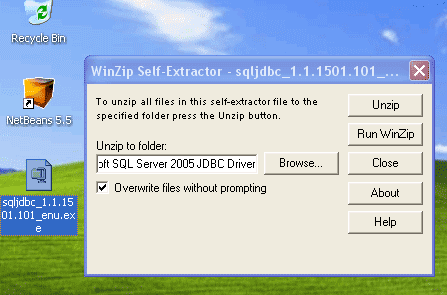
  • Double-click sqljdbc_1.1.1501.101_enu.exe to extract it.
    Extract the file 'sqljdbc_1.1.1501.101_enu.exe'

    • Then, you’ll see the folder that you’ve just extracted ( \Microsoft SQL Server 2005 JDBC Driver\sqljdbc_1.1\enu\ ), the file ’sqljdbc.jar’ which is the library that will be added to the library in NetBeans later.
      sqljdbc.jar
    • You can find more informations about JDBC Driver at \Microsoft SQL Server 2005 JDBC Driver\sqljdbc_1.1\enu\help\default.htm.
  1. Add JDBC Driver to the project on NetBeans. (Add a library)
    I will show by create New Java Application Project called TestSQL and add ’sqljdbc.jar’ that just get from previous step to the project’s library.
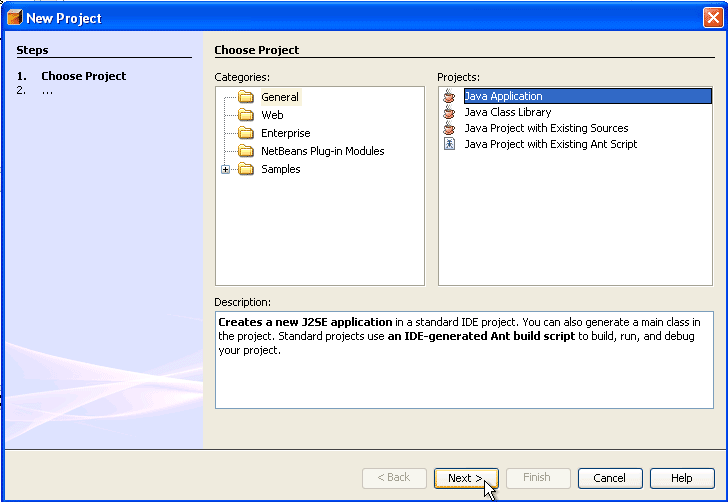
    1. Create New Project called TestSQL.
      Create New Java Application Project
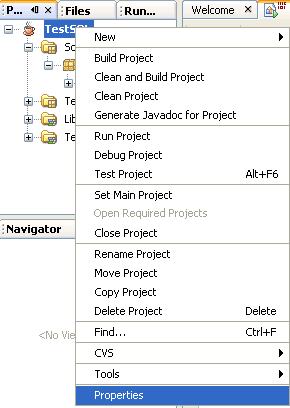
    2. In Projects window, right click the project name and select Properties.
      Project's Properties
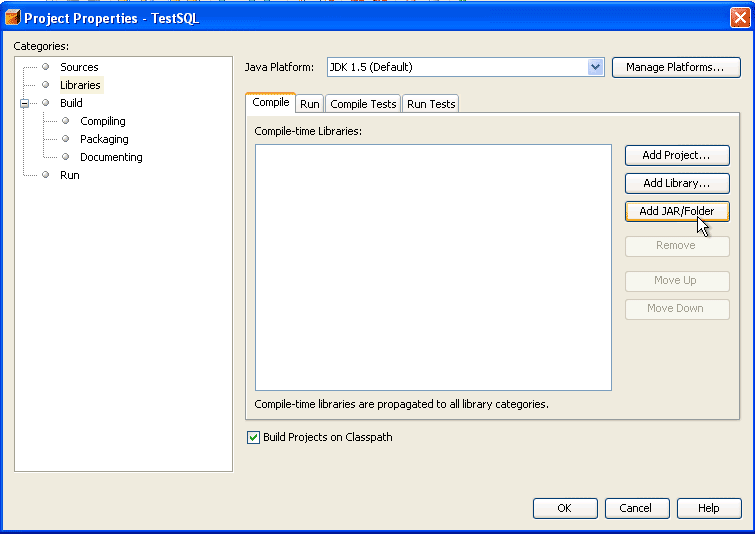
    3. Project Properties window appears. The Categories on left side, select Libraries. And on right side in Compile tab, click Add JAR/Folder.
      To add library file(s)
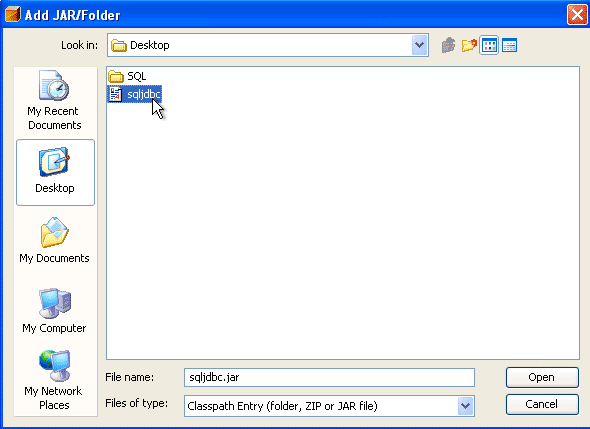
    4. New Window appears, browse to the file ’sqljdbc.jar’ and click Open.
      Select sqljdbc.jar file
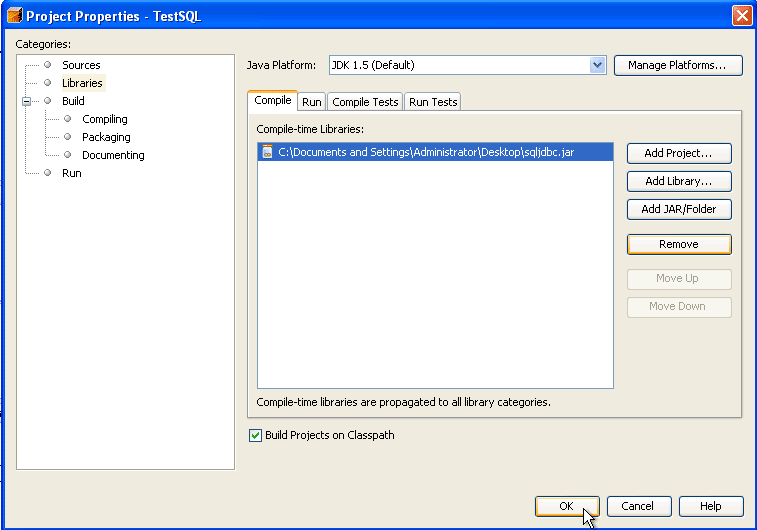
    5. You’ll see the .jar file was added to the project. Click OK to finish.
      A library was added
      Note: You should keep sqljdbc.jar in the directory that you won’t delete it (ex. not in temp folder). May be in the same directory that keep common library files. If you delete the file without delete a link from the project, the project will show error about missing library.
  2. Connect to the database
  3. Now it’s the coding time. I going to show how to connect to SQL Server. Assume that I have SQL Server 2000 running on local machine. Let continue from the project just created in previous step, in main.java.

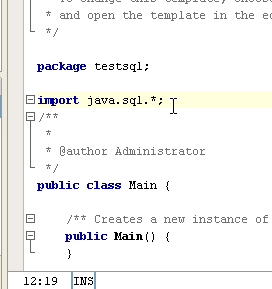
    1. I’m going to use Connection and DriverMapper Classes so I need to import libraries.
      import java.sql.*;
      import java.sql.*;
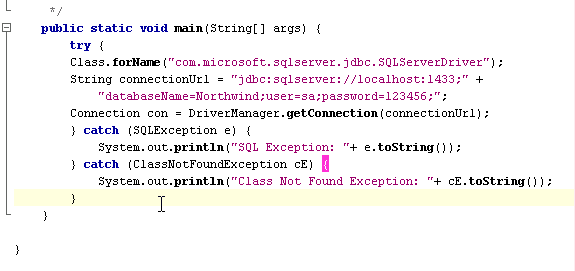
    2. Now I will connect to my SQL Server on local machine, the Northwind database(a sample database in SQL Server 2000). In main method, add the following code.
      try {
      Class.forName("com.microsoft.sqlserver.jdbc.SQLServerDriver");
      String connectionUrl = "jdbc:sqlserver://localhost:1433;" +
      "databaseName=Northwind;user=sa;password=123456;";
      Connection con = DriverManager.getConnection(connectionUrl);
      } catch (SQLException e) {
      System.out.println("SQL Exception: "+ e.toString());
      } catch (ClassNotFoundException cE) {
      System.out.println("Class Not Found Exception: "+ cE.toString());
      }

      The code explanation:
      • Class.forName(”com.microsoft.sqlserver.jdbc.SQLServerDriver”); means load the SQL Server driver.
      • localhost:1433 refers to connect to SQL Server at localhost port 1433 (default port).
      • databaseName=Northwind refers to the database name you want to connect to.
      • user and password refer Username and Password that used to connect to the SQL Server.

      Connect to Northwind

    3. Compile and run the project. If no error occurs, it means that the connection has established successfully.

That’s it for part I. Now you know how to connect to SQL Server on NetBeans, the part II will coming soon.


Monday, September 24, 2007

Secrets Of Successful Traders

Don't need to make money from the stock market with this incredibly
simple and fail-proof strategy.
1.You don't need money
In fact, you can practically get started with as little as $1,000 and
can still make $1,000,000.00 in 5 years or less.
Increase your initial amount and you can achieve the target of 1
Million in much lesser time. All I want from your side is desire to
make money, consistency and the determination
2.Don't waste your time doing unnecessary research
You absolutely don't need to spend hours reading charts, doing
technical analysis and stuff like that.
Secrets of Successful Traders will tell you how you can trade better
than stock market professionals spending as little as approx. 20
minutes a day.
I guarantee, it won't take more than 20 minutes if you follow my
strategy correctly.
And yes, there is no technical analysis involve in this.
3.You don't need to be a rocket- scientist to follow my priniple
The concept I'm going to reveal in Secrets of Successful Traders EBook
is extremely easy and you don't need to be highly knowledgeable to
understand the strategy.
I promise you even a 10 year old kid can understand it in 30 minutes
and implement it instantly after reading this book.
THIS IS NOT a major hoops to jump through concept which looks good on
paper but impossible to apply.
The entire concept is explained in detail with the help of pictures,
graphs and examples to make the entire learning a lot easier.
This ebook is suitable for beginners as well as experienced traders.
Both of them can take advantage of that.
4.Say Goodbye To Complex Theories
Our trading method is not based on any sort of charting or technical
analysis and you absolutely don't need to learn Gann, Febnocci or
Bollinger or anything like that.
It is rather a fail proof method to easily, quickly and, most
importantly, consistently make money from the stock market.
This book is NOT designed to instruct you "how to read charts" and you
will not find anything about the Febnocci curves, Bollinger bands or
complex mathematical theories in the entire 120+ pages EBook because
they are not required in order to trade successfully into the stock
market.
5.Never Pay Again For Software, Subscrition etc.
You don't need to pay for any other expensive subscriptions, tips,
books, systems, seminars etc.
This book will not only reveal that closely guarded secret but it will
also cover everything you need to know about stock market. For e.g.
How does stock market functions, How to select brokers, Money
Management and lot more.
http://stockt.docspages.com/strategy.ht

all the information are taken from http://groups.google.com/group/misc.invest.stocks/browse_thread/thread/e67e4959e45a3c7b/8fa11f50524f4b34#8fa11f50524f4b34

What Are Shares - A Quick Basic Guide To Investments

In an effort to raise funds in order to help with business expansion efforts, there are several possible options open to a company. One route that can be taken is to set up a loan, and then pay interest on the money borrowed to pay off the debt, while another method which many companies take instead is to give up some degree of ownership in the company and issue shares (or equity). In essence, shares are simply a method of representing some degree of ownership of a company. When an investor buys shares they then become a part owner of that company along with any other share owners.

By investing in shares, an investor gains a stake in the company and can become involved in choices such as who should manages it and are involved in making key decisions such as whether the business should be sold. The amount of influence an individual shareholder can exert over the running of the business is based on the total number of shares they hold as a percentage of all the company shares which have been issued. By becoming a shareholder, the investor can also expect to benefit from any profits which the company makes, in the form of a shares dividend pay out and/or capital growth through the market value of the shares increasing.

While shares are usually associated with stockmarket trading, most small companies which issue shares will sell them to friends and family, or business investors in order to provide funds to enable growth through formal equity funding finance. Sometimes shares are also offered as part of company or personal pension schemes, through endowment mortgages, given out in the course of a company privatisation or occasionally as part of a building society conversion, known as demutualisation.

Those companies that choose to offer their shares to the public are known as public companies and these shares are often bought and sold through the various stock exchanges throughout the world. The value of the shares can go up or down, depending on market forces, and whether the company is performing well, based on the laws of supply and demand. If a company is doing well, then share prices may rise, while a poorly performing company might expect share values to fall. It should be noted that the value of share can also affected by the overall level of confidence within the domestic economy as a whole, as well as the global economic climate.

With the growth of share ownership, there has also been an increase in the amount of information that is available to potential shareholders. Government information sites like the Financial Services Authority and some corporate businesses like Barclays Stockbrokers, offer information to help visitors decide whether buying shares is the best type of investment opportunity for them, as well as guides on how to protect against the ever present possibility of potential financial loss.

Until not so long ago, the idea of owning shares was something many people thought was beyond their reach. However many people now own shares, often without knowing it, as part of their general savings investments. As times have changed there are now tremendous opportunities being created by share ownership, and some level of share dealing is within the grasp of almost everybody.

Disclaimer: All information contained in this article, is for general information purposes only and should not be construed as advice under the Financial Services Act 1986. While share dealing can offer lucrative financial opportunities for careful investors, it is always important to note that share values can go up as well as down, and all investors must gauge their own preferred level of perceived risk. You are strongly advised to take appropriate professional and legal advice before entering into any binding contracts.

Michael is a keen writer living in Edinburgh. Michael's Website: Taxis Belfast

Trading requires time in a couple of ways. The first is the time dedicated to developing a trading system. This can be thought of as a one-off thing, but in reality it is more an on-going process. Once a system is in place, time is required in terms of monitoring the markets for signals, executing transactions, and managing positions. How much time all these different elements require depends on the trading system. The trading system, in turn, needs to take in to account the amount of time the trader has available. This article discusses the considerations which go in to helping one determine their best trading timeframe.

The first question to be answered is how much time each day/week/month (whichever is most appropriate) can you dedicate to the various requirements of trading and managing a trading system? Different trading styles require different time focus. As a rule, the shorter-term the trading, the more specifically dedicated time required. A day trader, for example, runs positions which are opened and closed during the same session. This normally means a lot of time spent watching the market for entry and exit signals. An intermediate or longer-term trader who holds trades for weeks or more does not have to dedicate the same amount of time to watching the markets. He or she can usually get away with only spot checking from time to time. Of course there is a whole array of possibilities in between. Knowing where you fall in the spectrum of possibilities is an important part of developing your Plan.

At this point it is also important to consider distractions. There is a major difference between having 6 hours per day of uninterrupted time to watch the markets and having 6 hours of time during which you will be making and receiving phone calls, having meetings, and otherwise not being able to focus on the markets and make trades when required. In the former case one could day trade. In the latter, however, day trading would probably be a disaster as the trader would most likely miss important trading situations on a frequent basis. This sort of thing needs to be taken in to account.

The basic decision one has to make is in what timeframe the trader can reasonably expect to operate on a consistent basis. The individual must be able to do all the data gathering, research, market analysis, trade execution and monitoring, portfolio management, and any other functions required of her or his trading system. That means a trading timeframe has to be selected which allows the trader to handle all of these duties on a consistent basis without the kinds of disruptions which can cause poor system input from the user, and therefore poor system performance.

By the way, nothing says a trader cannot operate in multiple timeframes. The point of this assessment is really to determine the shortest timeframe realistically workable for the trader. He or she would then certainly be able to trade in ones longer-term than that base point. For example, just because one has the ability to day trade does not mean he or she cannot operate in a longer-term trade horizon.

One other thing to consider, especially where it relates to short-term activity such as day trading, is time of day. It is all fine and good if a trader has 8 hours of uninterrupted free time available during which to trade. What if that time is between 6:00pm and 2:00am Eastern, though? None of the primary US markets is open then, so the day trading options are a little thin for a US-based trader. (Forex might be an option).

It is also worth stating, as a final comment, that sometimes trading is not a good idea. We all go through spells in our lives when we are distracted by any number of things. This can be through illness, injury, family or relationship issues, or work-related stress. These tend to be temporary in nature, but nevertheless are a factor in our trading. If you cannot focus on trading the way you need toand by that we mean following your planthen no timeframe is going to be the right one. Its perfectly fine to take time off and not trade.

John Forman is author of The Essentials of Trading (Wiley - April 2006), and a near 20 year veteran of trading and analyzing the markets. Visit Anduril Analytics to learn more about his trading, market analysis, and research activities and to find out how you can get a copy of Anduril's free report on what every trader and investor needs to succeed.

Five Fundamental Steps To Successful Stock Option Trading

Stock option trading presents the opportunity to potentially make a fortune trading options than almost any other form of online trading in todays market. The level of reduced risk combined with above average leverage allows a skilled option trader the chance to make sizable gains but an aspiring option trader must have a solid understanding about what creates a reliable option trading method to insure long term success at option trading. There are five fundamental steps that any option trader must implement when creating a superior stock option system.

To begin with you must realize the affects of time on the premium of the option you are choosing to trade. There are two parts you must factor when considering time into the stock option trading process. The first part that has to be considered is the time left on an option till expiration. Since stock options have a defined time period of anywhere from 30 days up to three years in some cases then you must be sure to select the proper stock option with enough time on it in order to profit. You must be sure that you purchase the correct option containing enough time on it to insure that time decay doesnt erode your investment away before your position has enough time to be profitable.

This brings us to the second part of the option selection process of trading options successfully is factoring time into your trading system. Trading a particular stock option and knowing the key factors of your option trading system or setup by knowing the average time period of a trade once it has been signaled and entered. For example, if your average holding time for an option trade is five days then you dont want to buy an option with four months of time premium left on it because you would be paying more for the extra time with the options purchase price. Nor would you buy an option with less than 30 days till expiration as time decay would eat away the value of option so rapidly that even if the stock options underlying stock moved favorably in your direction the time decay would be so great you would be too late to capture a gain in the option itself.

The third step to successful stock option trading is comprehending the relationship of volatility between the market, the underlying instrument that the option is based on, and the effect is has on the cost of the option itself. When the stock market as a whole as an index goes thru periods of low volatility or experiences low trading volume then the stocks that make up the market tend to follow general market and also begin to follow suit with periods of low volatility which cause cause the value of stock options to become cheap. However if the general markets volatility begins to spike it causes individual stock option premiums to increase in value as long as the market moves in the traders favor.

The fourth key in successful stock option trading is having a trading method that takes factor these key steps into giving clear entry signals, clear exit signals, a defined system of trade management, and a profit factor greater than your average loss over a series of trades. Understanding all steps of various trade setups is meaningless if you dont have a trading system that guides you through each step of the trade management process. A solid trading stock option system guides you by the hand and details each step while guiding you towards being a consistent winning trader in the markets and being profitable in the end.

The fifth and final step to trading stock options successfully is trading psychology. Traders and there mental makeup are usually complex so it is very important that stock option traders have a sound stock option trading system or method that factors this into their overall approach to trading the markets as well as the discipline to follow their trading methods. You can give two traders the same exact profitable trading system but its very likely that they will experience very different results. The reason for this is usually is because the one that has the ability to remain as detached from his losing trades as well as his winning trades while maintaining the discipline to follow the systems rules no matter the individual trading result will come thru as the most profitable trader in the end which shows us that it comes down to a superior mental process towards trading the markets.

Using these five steps as a foundation to create your own stock option trading system can help you avoid the mistakes of many other stock and option traders. By understanding time decay, factoring an options time into your trading method, how volatility impacts a stock options intrinsic value, what details a winning stock option trading system, and your own trading psychology you now have a the key steps to build your trading career on.

Would like to earn greater profits in today's markets? Sign up for a free newsletter and ebook at StockOptionSystem.Com and read more articles like this one at StockOpSys Article Directory!

5 Keys To Stock Option Trading

Stock option trading offers the skilled trader more potential for making a fortune option trading than almost any other form of online trading in todays market. The degree of controlled risk along with superior leverage allows a knowledgeable option trader the chance to make huge profits but an aspiring option trader must have a solid foundation of education about what makes up a sound option trading method in order to have a long term success at option trading. There are five essential keys that any option trader must understand when developing a winning stock option system.

First, you must understand the degree which time affects the premium of the option you are considering trading. There are two parts you must consider when factoring time into the stock option trading decisions. The first thing that you must take into account is the intrinsic time left on an option. Since options have a limited time period of anywhere from 30 days to several year depending on the particular option that you bought you must be sure that you purchase the correct option containing enough time on it to insure that time decay doesnt erode your investment away before your position has enough time to be profitable.

The second skill of trading options profitably is factoring time into your trading system in relation to trading a particular stock option and knowing the statistics of your option trading methodology or option trading setup by knowing the average holding period of a trade signal. If your average holding time for an option trade is seven days then you dont want to buy an option with three months of time premium left on it because you would be paying more for the extra time with the options purchase price. Nor would you buy an option with less that 30 days till expiration as time decay would erode the value of option so quickly that even if the options underlying stock movement moved favorably to you the time decay would prevent you from realizing a gain in the option itself.

The third thing to profitable stock option trading is understanding the relation of volatility between the market, the underlying stock that underlies the stock option, and the effect is has on the value of the option itself. When the general stock market as an index goes thru periods of volatility or low trading ranges the stocks that make up the market tend to follow overall trend and also begin to experience periods of low overall volatility which in turn can cause derivative like stock options to become cheap or low premiums. But if the markets volatility rises it is likely that individual stocks will follow the trend causing stock option premiums to increase in value given that the market moves in the traders favor. The next key in how to trade stock options successfully is having a stock option trading method that takes these key factors into consideration while giving clear entry signals, clear exit signals, a defined system of trade management, and a profit factor greater than your average loss over a series of trades. Knowing the ins and outs of various trade setups is useless if you dont have a trading methodology that guides you in every step of the trade process. A solid trading method holds you by the hand and defines each step while leading you to being a consistent winner in the markets and a profitable trader when all is said and done.

Finally, the fifth and final key to successfully trading stock options is yourself, particularly your trading psychology. Human beings and there mental makeup are extremely complex so it is extremely important that stock option traders not only have a sound stock option trading methodology but the discipline to follow their trading methods. You can give two people the same exact winning trading system but it is very common for them to have different results. Invariably, the one that has the ability to remain as detached from his losing trades as well as his winning trades while maintaining the discipline to follow the systems rules no matter the trading result will emerge the greatest winner in the end.

Using these five keys as a basis to develop your stock option trading methodology can help you avoid the mistakes and pitfalls of many beginning option traders. By understanding time decay, factoring an options time into your trading method, how volatility impacts a stock options value, what defines a reliable stock option trading methodology, and your own trading psychology you now have a foundation to develop into a winning stock option trader.

Would you like to learn cutting edge trading methods for trading stocks and options? Sign up for a free newsletter and ebook at StockOptionSystem.Com and read more articles like this one at StockOpSys Article Directory!

Online FOREX Trading This Simple Fact Could Make You Huge Profits

We are going to give you a simple fact here which many traders don't understand why it's so significant and never use it to their advantage.

If you do, then it could make you huge profits in online forex trading and ensure you never miss a major move again.

So here it is:

Most major trends start from new market highs NOT market lows.

Why is this so significant?

A major failure of many traders especially novice traders, is they always want to buy low and sell high or buy dips.

Of course, if they do this they will never catch major moves.

If most major trends start at new market highs then the way to make money is to buy high and sell higher

Most traders cannot do this:

They see a breakout from new market highs and think prices are now to high so they think "lets wait for the pullback to get in".

The problem is most of the time prices dont pullback, the trader never gets on board and sees a trade make $10,000 or more and their not in!

Breakouts are simply one of the best ways to trade and on breaks of significant support or resistance the odds of the trend continuing are good.

You can therefore get in with the odds on your side, with clearly defined stops below the breakout.

Breakouts allow you to trade on confirmation and thats why its such a great way to trade.

Yes, it can be uncomfortable as you wont be in at the bottom or sell at the top, but you cant do that anyway and you know the odds are on your side.

How to trade breakouts.

1. Look only for significant support and resistance that has been tested several times and preferably with months in between tests.

2. Trade only if prices close above resistance. Many times prices can spike through resistance in a day session and fall back, so wait for the close of US Trading.

3. Place your stop behind the breakout point, once the break is under way.

4. Do not trail up your stop to quickly.

5. If you are worried about short term volatility, buy at the money or in the money options to give you staying power.

6. Never predict a breakout. Only act on confirmation at the end of the day and before you take a position make sure momentum indicators point to further strength An indicator such as the stochastic is useful here.

Breakouts are simple to understand, easy to trade, offer great risk to reward and will allow you to hit the major big moves that help yield the big profits.

If you think "buy low sell high can make you money" Chances are it won't.

However if you buy high and sell higher you could make some huge profits.

MORE FREE TRADING INFO & A SYSTEM WITH A REAL TIME TRACK RECORD

On all aspects of becoming a profitable trader including info and for an exclusive Gann Trading Course visit our website at http://www.net-planet.org/index.html

Stock Market Quotes

Youre neither right nor wrong because other people agree with you. Youre right because your facts are right and your reasoning is right-and thats the only thing that makes you right. -Warren Buffett

It comes as a surprise that one of the oldest and the most rewarding of modern day enterprises have been investing in the stock market. Trading in the stock market lures many able-minded investors every day and every one comes in with the dream of making his/her fortune in the economy defining market of any country. Scores of books have been written on successful trading in this field and valuable experience has been passed over many generations of leading investors. The most important thing to remember while dealing with the ups and downs of the stock market is that the investor must get his facts in the right place and not be easily moved by the opinion of others. It is very easy to lose the right direction and become prey to ill advice. You must have confidence in your decisions and stick to the research done before investing in any venture in the stock market. It is true that the market is always in a state of flux and you will be tempted to do what others are most ardently following but this might bring serious downfalls to your trade if the same people had speculated wrongly.

While researching for the stock you wish to invest in, it is advisable to consult a professional firm for your information. A wide range of tools are available on the Internet with many financial sites offering the right facts and advices. You should definitely read stock reviews as well as financial reports of the stock you wish to invest in. It is a great exercise for the right investment and will surely reap you benefits in the long run. We must be sure of the decision we are taking and we must carry out extensive research of the quotes before taking the final plunge. Stock Market Quotes give us a fair idea of the feasibility of a particular stock being profitable in the future. By studying the trend carefully, you will surely be able to come up with a plan to gain the most out of a deal.

The Stock Market is the place where you and I can materialize our dreams and we must make the smart choice of researching the stocks and reviewing their quotes to optimize the result. Stock Market quotes are a mirror of the net worth of an investment and they usually help us in taking the right decision. By keeping these points in mind we can be rest assured that our hard earned money will not be under the blanket of high risk. You must also make sure that you are actually interested in the stock you wish to invest in as you will be naturally inclined to get more information about that particular stock leading to a better research. With a number of investment options in store for us today, the Stock Market is nearer to the realization of our dreams than ever before so we must grab the opportunity now and make our fortune as soon as possible.

Why Choose Sogoinvest:cheap trading stock options
Contact sogoinvest: Contact Online stock trading compan

Trading Stock Options

What you need to know about online investment - investing made easy?

Trading stock options are an easy and quick way to make money. Stock markets are an indicator of the health of the economy of a nation. A rising value of the stock market is determinant of a prospering economy. Initially trading was done by stock brokers on the behalf of people on the floor of the stock exchange. However, with the advent of the Internet, now stock market trading can be done online.

Online stock market trading allows a person to be in touch with the latest stock market developments while sitting at his place. All the necessary details about day trading are provided on the Internet. All a person needs for online stock trading is a computer and an Internet connection, and an online account to register themselves.

The best part of online stock trading is that online brokers charge a nominal amount in trading. However, certain things should be kept in mind while trading online. One should be careful in selecting the company for investing purposes. The selected company should be reputed, decorous and trustworthy. An investor should check the quality of expertise and services offered by a company. Also, examine the payment mode that it has made use of in the past. In addition to the payment mode, find out about the services provided by them, commission rates and the way they handle accounts. Enquire about the financial status of the company before investing in it. These trading companies keep their investor updated with all the developments of day trading.

Also, an investor can invest as per his comfort and desire without any limitation. An investor can invest in the stock market of any part of the world while sitting at his place. All the brokerage expenses and minute trading information is mentioned in the site. The information present is enough even for an inexperienced person to invest in the stock market. The services of an expert brokerage are important as an investor can not directly invest in the stocks. The investment is made through brokers who are members of the stock market.

Some of the other benefits of online stock market trading are :

  1. An investor can save a lot of time and money. He can invest as per his convenience.

  2. The charges of brokers range from $3 to $1 per trade.

  3. A trader can contact expert brokers in case of any guidance.

  4. Trading accounts can be accessed easily, and are provided with latest information on stocks.

However, an investor should be sure about the stocks in which he wants to invest. This is because, only if a person is sure, will he link himself to a particular site. For instance, if a person inclined to invest in the domestic market opens a site of the foreign market, it can be confusing.

It is important that the site on which an investor opens an account be secure, as personal and financial information has to be mentioned on the site. In case the site is insecure, it can cause information to be misused. Also, compare the fee charged by various investment sites before choosing one.

Why Choose Sogoinvest: cheap trading stock options
Contact sogoinvest: Contact Online stock trading company

Stock Dividend Record - What is a "Dividend Record" Where Can I Find It?

For those stock investors who may not know this, the Standard Poor or popularly known as (S&P), is a leading provider of independent investment research, market ratings as well as stock market indicators.

Standard & Poors (S&P) Dividend Record provides comprehensive information on dividend payments and corporate actions of over 22,000 equity securities.

It is available through S&Ps Data Services for a fee. S&P is widely accepted as the world leader in independent investment research. The information focuses on cash and stock distributions and consequences these will have on taxes. Mergers and acquisitions affecting dividend payments, redemptions, outcomes of stockholder meetings are also detailed.

Dividend Record focuses on companies listed on American and major Canadian exchanges, as well as selected foreign stock issues.

The information is accessible through the Internet direct from S&P. Information from Dividend Record can be used to research individual companies, market sectors, market indices, or the market as a whole. Emerging trends can be studied from the data. Even though the information isnt free, reports about the latest Dividend Record are widely reported every time the quarterly versions are published.

Mergent also publishes its version called, appropriately, Mergents Dividend Record.

Another use of the term dividend record has to do the date a company actually makes announced dividend payments. This record date is important because shareholders on record on that date will be paid. For example, a company would announce that it will pay a dividend on April 1 to shareholders on record as of March 15.

Don't miss the exciting tips on stock market trading and insiders information of finding divided record when you visit http://www.tradingsphere.com, the premier online stock trading portal and resources.

Day Trading Courses

Day trading is the practice of buying and selling currencies before the close of the Foreign Exchange each day hopefully for the most profit. Anyone with a little money to invest can now trade over the internet. But its best to know a little bit about what youre doing first and theres no shortage of day trading courses to teach you about that.

Courses can be studied online or in face-to-face classes and duration differs between one day to five days - or indefinitely if you teach yourself in an internet correspondence course.

You dont need any specific paper qualifications in order to trade but you do need a few skills and a bit of knowledge that you could gain through a day trading course.

You will need to shop around, because courses can cost anything between $2,000 and $12,000 and they vary massively in quality for these prices its not always true to say that the most expensive option is the best one; it all depends on what you are looking for.

Here are a few of your options so you can see which one might be right for you.

Online

Since Day Trading University came online, there have sprung up literally hundreds of websites offering day trading courses supposedly to university standard but be wary of these claims. These courses are unregulated, especially on the internet. You want to make doubly sure that they offer you the tuition you need.

Makes sure that the website you give your hard-earned cash to, to teach you day trading, is not simply an article directory. Thats not a substitute for a proper course in day trading and is probably not something that you want to be paying too much for. To maximize the benefit of an online course, it should offer you multimedia audio or video clips as well as downloadable activities and charts to continue and consolidate your learning.

Books
Home study courses in day trading are also available in book form. They are easy t peruse at your leisure and you can browse before you buy, so you know exactly what youre getting. But books dont have the multi-sensory approach that a good website will have, with audio and visual streaming. It works for some people though. Many are written by experts in the field.

Face-to-face courses
This is where you might be spending big bucks to learn about day trading: make sure its worth it.

Tuition can be large group, small group or even one-to-one, although you may have to pay through the nose for one-to-one tuition. Be sure you really need it before you lay out your course fee, bearing in mind that if you are assertive and confident enough, *any* face-to-face tuition offers you the chance to ask the tutor(s) any specific questions which you might have.

Here are a few things you should be looking for in a good day trading course, whether that be face to face, online or in a book:
What to trade in
OK so that one was obvious, but how do you spot an opportunity for bigger trading profits? A good course should tell you this. On the flip side, they should inform you of what sort of trading to avoid and why, so you dont make big, costly mistakes.

Trading psychology
What is the best mindset for a successful trader? What opportunities should you look for? Who makes the most money?

Long-term and short-term trading
Now, as were talking day trading here, there is no real long-term, but a good trading course will differentiate between deals you strike every few minutes and ones you should sit on for a few hours. You need to recognize these in order to maximize your profits. Find out how to pick momentum stocks every day to squeeze the most out of your money. Tools of the trade

A good course will not be trying to sell you anything, so watch out for courses and books linked to a particular product or automated trading software. Of course theyll tell you that is the best one but you know your own mind. Make it up yourself without the sales pitch.

However, day trading need not be about constantly sitting at your computer, glued to currency reports. Automated trading is a great boost to day trading, and a good course should give you some ideas of what automation software is out there and how to discriminate between the packages available.

Now you know some of the options as far as day trading courses go and what to look for, you should be able to find the right training option for you.

Frank J Vanderlugt owns and operates http://www.lazytrader.com

Day Trading

Fundamental Guide To Safe And Profitable Trading

The Attraction of Trading

Many seek to succeed in stock and option trading. But the majority loses in their endeavor to reach the success. The game doesnt seem as easy as it might look like. If you ever started trading and got confused of when to place order, when to take profit, how to protect your equity and you toiled with anxiety and hesitation in making decision, then you have come to the right site. Even if you are considering to start joining the trading world as a newbie and learn how to trade well and safe, this book will definitely serve as your fundamental guide in your attempt to develop your trading skills.

Stock and option trading has become a great attraction for decades, but why most traders lose and washed out of market? Emotional and careless trading is one of the most likely answer. Do you feel confident or anxious while place an order? Do you feel delightful or doubtful while close out a trade? Are you strongly elated while gaining profit from a trade and tensely sorrowed while losing from one?

Psychology is the Fundamental Key

Most traders expect to enter a good trade. Once they enter, they lose control by riding an emotional roller coaster and miss the essential factor of winning emotion management. Their inability to manage their emotion leads them to fatal failures.

Most of the time, traders are strongly influenced by their expectation of gaining high profit while at the same time lost their awareness of the market reality. Market is harsh and shows no pity. If you ignore movements in the market crowds, then you will miss out the chance of making money. To stand as a successful trader you need to keep your focus on reality, recognize the changes and trade based on them, not waste time and energy on regrets and wishful thinking.

Successful traders are hardworking and witty men/women. Ironically, their main goal is not to make money but to trade well. Trying to reach their best performance is far more important than making money. They are so focused on trading well and improving their skill that money no longer influences their emotion.

Traders who are not confidence at themselves always try to fulfill their wishes regardless of market reality. Once you enter a trade, you cannot control the price. Worrying about the price would only paralyse your focus and ability to trade. Stop worrying about where the price goes, but start worrying about what to do when it gets there and plan it ahead. By doing this, your trading is free from emotional response and becomes systematic and stress free.

If you do not plan ahead where are you going, you will end up somewhere you never wanted to be.

Emotional Trading

Your feelings and emotions have a significant impact to your trading success. You may have a fullproff profitable trading system, but if you feel upset, fear, arrogant or doubt while you trade, your account is sure to suffer. While you recognize a gamblers high or fear clouding your mind, stop trading. Your success or failure as a trader highly depends on managing your emotions.

The market does not know you exist. You can do nothing to influence it. You can only control your behavior. This is the same thing as a surfer cannot control the waves but he can control hismself not to be wash out by them.

A trader has to study trends and reversals the way a surfer studies waves. He must start with a small scale while learning to handle the market or precisely - himself. You can never control the market but you can learn to control yourself.

A new trader who has a string of winning trades often feels he can walk on the water. He starts taking wild risk and blow up his account. On the other hand, an amateur who suffers a streak of losses feels so demoralized that he cannot place an order even the obvious signal passes in front of him.

Fear and Greed

An amateur trader that feels elated or frightened cannot effectively use his intellect. When greed overwhelms him off his feet, he will make irrational and reckless trades only to suffer loss. When fear grips him, he will miss the profitable trades.

A professional trader uses his logic and stays calm. He acts accordingly to market reality not based on his own wishes claiming on unrealistic expectation.

The Myth

Most amateurs have a fantasy that in order to succeed they need to be highly educated and supplied with equipped with firsthand information. But the fact is that trading is intellectually quite simple. Good traders are often shrewd, but few of them are intellectual. Many do not have college background, and some even dropped out of high school. What separate winners from losers are neither intelligence nor secrets, and definitely not formal academic education?

Take the Full Responsibility

Successful traders are always aware of their decisions and take full responsible of their actions, while losers tend to blame someone or something for the consequences of their results.

You need to be aware of your tendency to sabotage yourself. Stop blaming your losses on others, situations or bad lucks and take full responsibility for the results. Records all the history of your trading, and learn from the failure. Look for repetitive patterns and make use of it for future benefits.

Plan Your Trade and Trade Your Plan

Planning a trade is the next step after you convince yourself to trade in emotionless manner. Your trades must be based on clearly defined rules. Take a look at the following scheme.

You are looking at a good stock X trading at $30 and you place a buy order at $32. The next thing you must do is making a plan of bad and good scenario.

Your plan could be like the followings. After I enter the trade: If the price goes down, where should I place my stop loss? How much can I bear to lose? If the price goes up, how much profit I expect to gain? How do I exit the trade? If the price goes my favor, should I buy more?

You already have those kinds of questions answered before entering the trade you place at $32. Your trade plan is filled in and you place your stop in $30.

The price goes up beyond your second buy order $37 and your stop is moved up to $35. The price keeps rising and you keep moving up your stop at a safe distance to protect your profit.

Your exit stop is hit at $45, and you sell almost mechanically and gain your profit without hesitation and regrets.

By learning to plan your trade and trade your plan, you know beforehand how to act on every situation that might occur. You will then be trading professionally and not emotionally. You wont be afraid of a loss too big to bear, or a profit too small to gain. Your trading will become systematic and stress-free.

Trading versus Gambling

What if you buy and the market immediately goes down? What if you sell and the market immediately goes up? Even the best traders lose money sometimes in some trades.

The answer is to draw a line between a business risk and a loss. A business risk is a maximum a mount of money you can bear to lose. There is no standard dollar amount as there is no standard business. A smart businessman will only take risks that will not put him out of business even he makes several mistakes in a row.

If a trader risks more than his business risk, he crosses the line that separates trading from gambling. Instead of intellectually and calmly cutting his loss, he emotionally expects for reversal without judging the market realistically. You can surely see this model in casinos and race tracks. To a gambler the whole market is like a big casino. He gets greedy and risk too much on a trade, and short streak of losses wipes him out of market

If you bail out of trade within you business risk, it is normal. There is no bargaining, no waiting, no emotionally hoping for another tick. If you take this concept of business risk, it will change your entire paradigm of trading and your way of money management. This concept give you a distinctive picture between trading and gambling.

Money Management

Money management is a very important tool to ensure survival, to avoid your from being put out of business. Money management helps you gain a steady rate of return as well.

As a guide, 2 percent rule keeps you out of risky trades that can do harm to your account. For example, you have $10,000 in your account, you may only risk up to $200 per trade. If your plan triggers an attractive trade with a $150 risk, then you may only trade one contract. If the risk is only $50, then you can afford to trade two contracts. Even if you want to add up your positions while the market moves in your favor, this rule must be followed as well providing you are at a break-even position and you move up your previous stop. You make sure the additional positions do not exceed 2 percent of your trading equity.

Conclusion

If you keep trading less emotionally and stick to you money management rule, your trading will definitely be stress-free and you can focus on analyzing the market. This report serves as an essential and fundamental guide needed by every trader. In addition to this report, you may want to continue to studying market analysis to improve your trading knowledge. Please refer to www.SafeStocktradingSecrets.com/recommend.htm for more information.

Hopefully this simple and basic guide will be useful to you. Wish you a safe and profitable trading. Good luck.

Guide to safe, profitable and stress-free trading
Sincerely,
Joshua Stephanus
http://www.SafeStocktradingSecrets.com
info@SafeStocktradingSecrets.com

Newton's Laws of Stock Market Trading

This revelation had me surprised too. I was idly flipping through my old physics textbooks yesterday when it suddenly struck me. I was amazed to realize that Sir Issac Newtons laws of physics points to so many profound and important rules in the stock markets today.

So, here we are the physics of the stock markets.

Newton's First Law of Trading

A Stock at rest tends to stay at rest and a Trending Stock tends to stay in trend unless acted upon by an equal and opposite reaction or an unbalanced force.

This law teaches us the same thing the old commodity traders will that the trend is your friend. If a stock is trending sideways, it tends to stay sideways until a powerful enough market force takes it out of its trend. If a stock is trending up or downwards, it will tend to stay moving up or downwards until drastic changes happen to the company or the market at large creating an equal and opposite reaction. We should therefore always trade in the direction of a trend and always be vigilant for signs of an equal and opposite reaction or the unbalanced force. Such a force may take the form of a drastic change in the market sentiment at large or drastic change in the performance of the specific company in question.

Newtons Second Law of Trading

The acceleration of a stock as produced by a market consensus is directly proportional to the magnitude of that consensus, in the same direction as the consensus, and inversely proportional to the mass of the stock.

This law teaches us that a stock moves up or down into a trend due to a force created by market consensus. How much a stock moves up or down that trend is determined by the magnitude of the market consensus and how massive a stock is. By massive we are talking about the price of a stock. The more expensive a stock is, the more well established the company has been and the lesser in percentage you will make out of the same move in absolute dollar versus a smaller, less massive stock.

The force of the market consensus is directly proportionate to the event that spurred it. If a company produces a breakthrough product on a worldwide patent, it creates an extremely strong market consensus that is likely to take a stock very far. If a company merely scores a marginally higher earning this quarter, it is unlikely to produce a market consensus that will go very far.

Newton teaches us to not only look at what the news is but also how well established the company is in order to determine how much momentum it will produce in a given trend. The same breakthrough that drives a small companys shares up by hundreds of percentage points may perhaps move a big companys shares only by a fraction of that percentage.

Newtons Third Law of Trading

"For every action, there is an equal and opposite reaction."

No need to explain this one in much detail, do I?

For every buying or selling, there must be an equal amount of buyers or sellers on the other side. The stock market is a zero sum game. For every buyer, there must be a seller and for every seller, there must be a buyer. The real question is, who is profiting from each of their buying and selling. There is really no such thing as more buyers today than sellers or vice versa. Every trader needs to understand that you can be on the wrong side of the table at anytime and only a sensible portfolio management system can help you go in the long run.

I have traded actively in the stock markets for over a decade and survived with ancient wisdom such as what you have read here. There is indeed wisdom to be found in every corner of our life and if we care to look carefully, we will never be in a lack of guidance.

For more of the wisdom that have prospered me so far, please visit http://www.MastersoEquity.com

Jason Ng is the Founder of Masters 'O' Equity Asset Management. He is a fund manager specialising in options trading and his Star Trading System has helped thousands. Please visit http://www.MastersoEquity.com.